
A systematic methodology to develop bottom-up coarse grained models for sequence-specific polypeptoids
This approach enables simulation of long polymer chains and multi-chain systems that are otherwise computationally inaccessible with atomistic methods.
PIs and Institution
Daniela M. Rivera Mirabal ; Sally Jiao ; Shawn D. Mengel ; Rachel A. Segalman ; M. Scott Shell, UCSB
Achievement
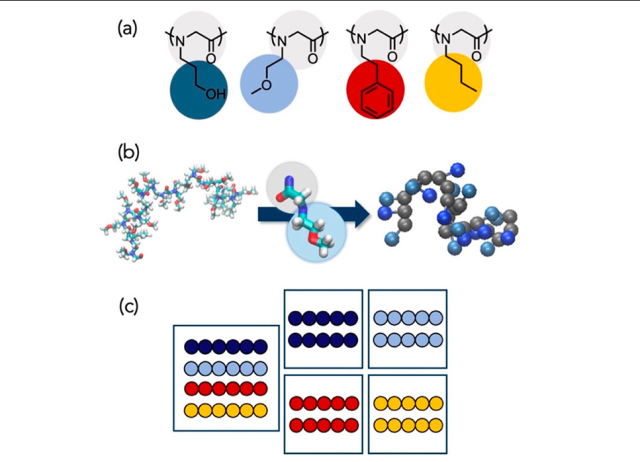
A systematic, bottom-up framework was developed to construct coarse-grained models for sequence-specific polypeptoids, enabling efficient simulation of their structure and assembly across length scales. Using a relative entropy–based approach, the researchers generated transferable coarse-grained interaction potentials directly from atomistic simulations, without relying on experimental parameter fitting. The resulting models accurately reproduce sequence-dependent conformational behavior and intermolecular interactions across diverse chemistries. This approach enables simulation of long polymer chains and multi-chain systems that are otherwise computationally inaccessible with atomistic methods.
Importance of the Achievement
Sequence-defined polymers such as polypeptoids offer vast design flexibility, but their large chemical space makes experimental screening and atomistic simulation impractical. This work establishes a predictive computational framework that enables rapid exploration of how sequence and chemistry influence polymer structure and assembly. By reducing computational cost by orders of magnitude while maintaining molecular fidelity, the approach opens new opportunities for high-throughput, in silico screening and inverse design of functional materials. This capability is particularly important for accelerating the development of sequence-programmable polymers for applications in coatings, biomaterials, and nanostructured systems.
Synergies with BioPACIFIC MIP
BioPACIFIC MIP enabled this work through access to advanced computational resources for large-scale molecular simulations, as well as facilities supporting peptoid synthesis and characterization. These capabilities contributed to the development and validation of the multiscale modeling framework and its connection to experimentally relevant systems.
