

Spatially Aware Diffraction Mapping Enables Fully Autonomous MicroED
REyes accelerates data acquisition while achieving data quality that matches or exceeds that of trained experts
PIs and Institution
Dmitry B. Eremin, Kunal K. Jha, David A. Delgadillo, Hongyu Zhang, Samuel H. Foxman, Samuel N.Johnson, Niko W. Vlahakis, Duilio Cascio, Vincent Lavallo, Jose A. Rodríguez, and Hosea M. Nelson, Cal Tech, UCLA, UC Riverside
Achievement
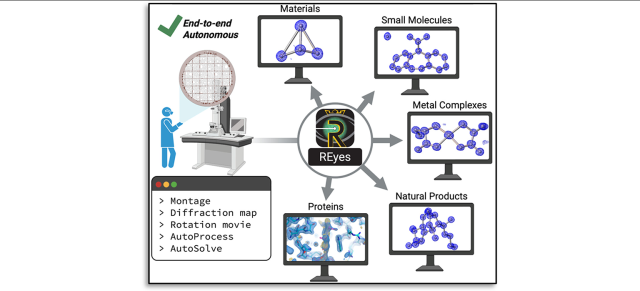
The researchers developed a software platform, Reciprocal Eyes (REyes), that enables fully autonomous determination of 3D atomic structures from microcrystal electron diffraction (MicroED) data. Traditionally, this process required manual selection of crystals under a microscope, a slow and user-dependent step that can introduce bias. In contrast, REyes scans the entire sample grid in diffraction mode, identifying crystals based on their interaction with the electron beam and applying a quantitative scoring algorithm to select optimal targets. The system then autonomously collects and processes diffraction data to generate complete molecular structures without human intervention. The platform was validated for solving structures for a wide range of materials, including minerals, vitamins, peptides, metal complexes, natural products, and a protein.
Importance of the Achievement
MicroED is a powerful technique for determining precise atomic structures, with broad applications in drug discovery, materials science, and natural products chemistry. However, its adoption has been limited by the need for significant technical expertise. By removing this human bottleneck, REyes accelerates data acquisition while achieving data quality that matches or exceeds that of trained experts. Notably, it performs effectively on complex, real-world samples, such as identifying mescaline directly from crude cactus extract without prior purification. As a freely available platform for academic use, REyes has the potential to democratize access to MicroED and significantly accelerate discovery across chemistry, biology, and medicine.
Synergies with BioPACIFIC MIP
The utilization of the BioPACIFIC MIP Spectra 300 (MicroED) was an integral part of this project. In addition, this project was made possible by the expert guidance of Matthew Mecklenburg, a BioPACIFIC MIP project scientist at the UCLA campus. This research closely aligns with BioPACIFIC MIP's mission of high-throughput analysis and data driven material discovery.
