

Restoration of weak localization in bilayer graphene by a molecular thin film
Molecular thin films can selectively tune these scattering mechanisms without degrading electronic performance
PIs and Institution
Anise Mansour, Movindu K Dissanayake Mudiyanselage, Matthew Mecklenburg, and Claudia Ojeda-Aristizabal, California State University, Long Beach
Achievement
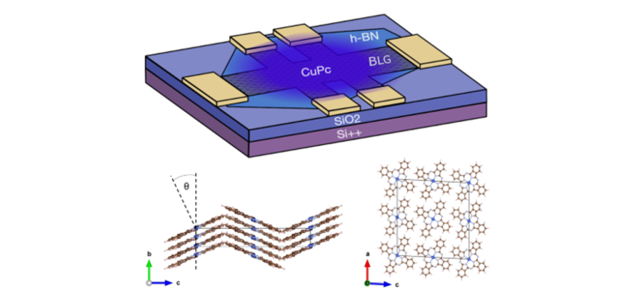
A molecular thin film was shown to modulate quantum transport in bilayer graphene by restoring weak localization, a key quantum interference effect. By integrating a copper phthalocyanine (CuPc) thin film with a bilayer graphene/h-BN heterostructure, enhanced quantum interference was observed through low-temperature electronic transport measurements. The molecular layer induces significant charge transfer (~3.6 × 10¹² cm⁻²) while largely preserving carrier mobility. Analysis of scattering mechanisms revealed that the molecules reduce trigonal warping–related scattering, increasing the intravalley scattering time and enabling stronger quantum coherence in the system.
Importance of the Achievement
Controlling quantum interference and scattering in two-dimensional materials is critical for next-generation electronic and quantum devices. In bilayer graphene, weak localization is often suppressed by intrinsic band structure effects such as trigonal warping. This work shows that molecular thin films can selectively tune these scattering mechanisms without degrading electronic performance. Unlike approaches that introduce disorder or strong spin–orbit coupling, this strategy preserves mobility while modifying quantum transport behavior. This provides a new route for engineering quantum phenomena in layered materials, with potential applications in molecular electronics, sensing, and quantum device design.
Synergies with BioPACIFIC MIP
BioPACIFIC MIP enabled this work by providing access to 4D scanning transmission electron microscopy (4D-STEM) for characterization of the molecular thin films. These measurements were critical for resolving the nanoscale structure and crystallinity of the CuPc films, enabling correlation between molecular organization and electronic transport behavior.
