
Protein-Delivering Polyelectrolyte Complex Hydrogels: Structure, Swelling and Dissolution Characteristics, and Release Behavior
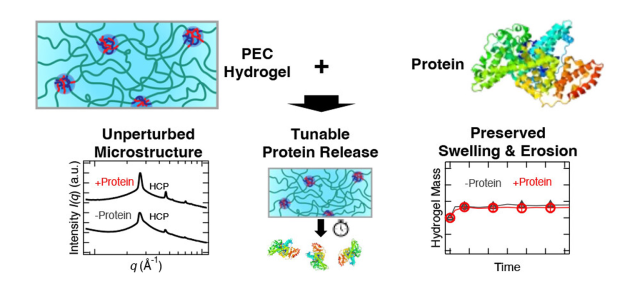
The study shows that protein inclusion does not compromise hydrogel structure or mechanics, enabling reliable performance.
PIs and Institution
Holly Senebandith, Khin C. Pyone, Marlo O. Taylor, Fahed Albreiki, Maanasi H. Dhiraj, and Samanvaya Srivastava, UCLA
Achievement
A tunable hydrogel platform was developed for controlled protein delivery using triblock polyelectrolyte complex (PEC) networks that self-assemble in water without the need for UV cross-linking or organic solvents. The study demonstrates that proteins can be incorporated into these hydrogels without disrupting their internal structure, even across a range of protein sizes and concentrations. By systematically varying polymer architecture, particularly end-block length and concentration, the researchers achieved precise control over hydrogel swelling, dissolution, and mechanical behavior. These parameters, in turn, enable predictable tuning of protein release profiles from rapid (minutes to hours) to sustained (weeks).
Importance of the Achievement
Delivering protein therapeutics in a controlled and predictable manner remains a major challenge in biomedical engineering. Many existing hydrogel systems require harsh fabrication conditions or suffer from burst release and poor tunability. This work establishes PEC hydrogels as a versatile alternative that combines mild processing conditions with highly programmable behavior. Importantly, the study shows that protein inclusion does not compromise hydrogel structure or mechanics, enabling reliable performance. The ability to independently tune release kinetics through polymer design, rather than chemical modification of the protein, provides a powerful framework for applications in drug delivery, regenerative medicine, and biomaterials design.
Synergies with BioPACIFIC MIP
BioPACIFIC MIP enabled this work by providing access to small-angle X-ray scattering (SAXS) instrumentation and expertise. These measurements were critical for resolving the nanoscale structure of the PEC hydrogels and confirming that protein incorporation does not disrupt their self-assembled architecture.
