

Polymer Sequence Alters Sensitivity and Resolution in Chemically Amplified Polypeptoid Photoresists
Precise control of polymer sequence provides a new molecular design parameter for improving resolution
PIs and Institution
Cameron P. Adams, Carolyn Henein, Xiangxi Meng, Chenyun Yuan, Javier Read de Alaniz, Christopher K. Ober, and Rachel A. Segalman, UCSB
Achievement
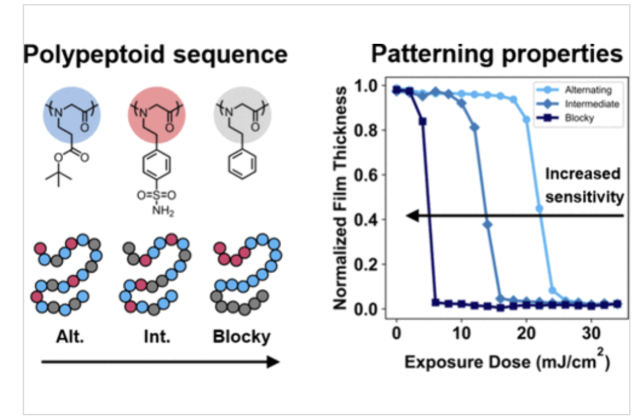
Researchers demonstrated that polymer sequence plays a critical role in determining the performance of chemically amplified photoresists based on sequence-defined polypeptoids. By systematically varying chain length and monomer arrangement while maintaining constant composition, the study revealed that both molecular weight and sequence distribution significantly influence photoresist sensitivity, resolution, and pattern fidelity. Alternating monomer sequences produced more uniform nanoscale features, while blocky sequences showed higher sensitivity but reduced resolution. These results establish sequence-defined polymers as a promising platform for next-generation lithographic materials..
Importance of the Achievement
Continued advances in semiconductor manufacturing rely on the ability to pattern features at sub-10 nm length scales using extreme ultraviolet lithography. Traditional photoresists often suffer from nanoscale heterogeneity that introduces stochastic defects and limits pattern fidelity. This work demonstrates that precise control of polymer sequence provides a new molecular design parameter for improving resolution and reducing variability in nanoscale patterning. Sequence-defined polypeptoids offer a pathway toward more uniform, predictable materials that support continued scaling of microelectronics and advanced nanofabrication technologies.
Synergies with BioPACIFIC MIP
BioPACIFIC MIP supported this work as part of a major in-house research effort focused on sequence-defined polymers for advanced materials applications. The platform provided access to shared synthesis capabilities and expertise for the preparation of precision polypeptoids, enabling systematic investigation of how polymer sequence influences photoresist performance. These capabilities supported the development of next-generation lithographic materials with improved nanoscale control.
