
Designing Highly Conductive Anion Exchange Membranes: Tuning Domain Continuity with ABC Block Copolymer Self-Assembly
Tuning Domain Continuity with ABC Block Copolymer Self-Assembly
PIs and Institution
Alexandra J. Macbeth, and Geoffrey W. Coates, Cornell University
Achievement
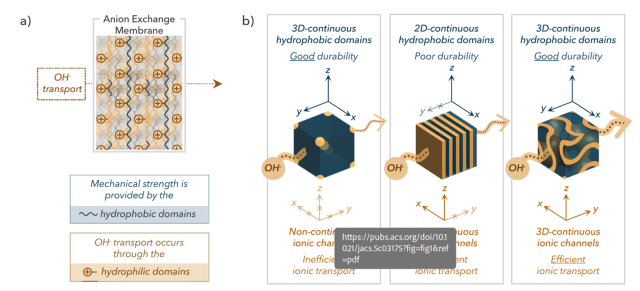
Researchers developed a series of precisely controlled ABC triblock terpolymers that self-assemble into distinct nanoscale morphologies, enabling direct investigation of how domain continuity influences ion transport in anion exchange membranes. By systematically varying polymer composition while maintaining similar molecular weight and ion exchange capacity, the study isolated the role of morphology in governing membrane performance. Materials exhibiting three-dimensionally co-continuous network structures showed significantly higher hydroxide conductivity and improved dimensional stability compared to membranes with lamellar morphologies.
Importance of the Achievement
Anion exchange membranes are key components in electrochemical energy technologies, including fuel cells and electrolyzers for green hydrogen production. A central challenge in membrane design is balancing high ionic conductivity with mechanical durability under operating conditions. This work demonstrates that controlling nanoscale domain connectivity provides a powerful strategy for improving ion transport without compromising structural stability. The findings establish new design principles for polymer electrolytes and advance the development of high-performance materials for clean energy applications.
Synergies with BioPACIFIC MIP
BioPACIFIC MIP supported this work through access to small-angle X-ray scattering (SAXS) instrumentation, as well as the expertise and guidance of project scientists Phillip Kohl and Youli Li. These contributions enabled detailed characterization of nanoscale morphology and helped establish the relationship between domain structure and membrane performance.
