

Complementary biomolecular coassemblies direct energy transport for cardiac photostimulators
PIs and Institution
Ze-Fan Yao, Phillip Kohl , Youli Lid , and Herdeline Ann M. Ardoña, UCI
Achievement
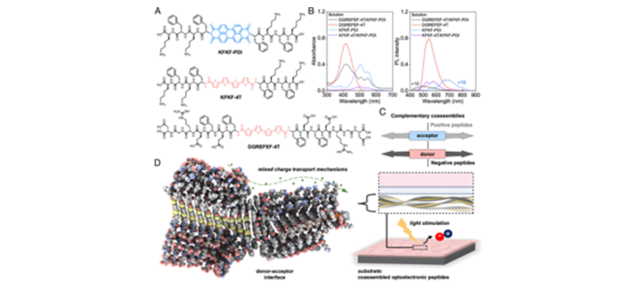
A biomolecular photostimulation platform was developed using self-assembled, π-conjugated peptide nanostructures that convert light into electrical signals at the cell interface. By designing complementary peptide sequences that drive donor–acceptor coassembly, the researchers created ordered nanostructures capable of efficient energy and charge transport. These materials generate photocurrents under physiological conditions and can be integrated into soft biomaterial interfaces. When interfaced with cardiomyocytes, the system enables light-driven modulation of cellular behavior, including changes in contraction dynamics and gene expression, without the need for genetic modification.
Importance of the Achievement
Controlling electrical signaling in cardiac tissue is critical for both fundamental studies and therapeutic development, but existing approaches often rely on rigid electrodes or genetic modification. This work introduces a fully biomolecular alternative that combines soft materials, molecular programmability, and optical control. The ability to induce electrophysiological responses using light-responsive peptide assemblies opens new opportunities for non-invasive cardiac stimulation, bioelectronic interfaces, and tissue engineering. More broadly, it demonstrates how sequence-defined biomolecules can be engineered to perform complex electronic functions in biological environments.
Synergies with BioPACIFIC MIP
BioPACIFIC MIP enabled this work through access to small-angle X-ray scattering (SAXS) instrumentation, which was critical for characterizing the nanoscale structure and ordering of the peptide assemblies that underpin their optoelectronic function.
