

Combating Reactive Oxygen Species (ROS) with Antioxidant Supramolecular Polymers
by incorporating glutathione functionality into peptide amphiphiles that self-assemble into nanofibrous hydrogels
PIs and Institution
Penelope E. Jankoski, Zacchaeus M. Wallace, Loria R. DiMartino, Jessica Shrestha, Ashe M. Davis, Iyanuoluwani Owolabi, Alex S. Flynt, and Tristan D. Clemons, University of Southern Mississippi
Achievement
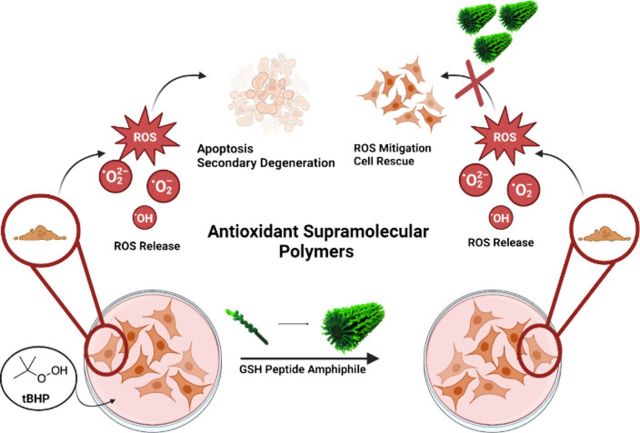
Researchers developed antioxidant supramolecular polymers by incorporating glutathione functionality into peptide amphiphiles that self-assemble into nanofibrous hydrogels. These materials effectively scavenge reactive oxygen species (ROS) while maintaining structural integrity as injectable or gel-based biomaterials. The supramolecular polymers demonstrated the ability to protect cells from oxidative stress at significantly lower concentrations than free glutathione, highlighting the advantage of presenting antioxidant functionality along a polymeric scaffold.
Importance of the Achievement
Excess reactive oxygen species contribute to tissue damage in a wide range of diseases and injuries, including cardiovascular disease, inflammation, and traumatic injury. Conventional antioxidant therapies often struggle to achieve effective localization or sustained activity. This work demonstrates a macromolecular strategy that combines antioxidant activity with biomaterial scaffolding, enabling localized ROS mitigation while supporting tissue regeneration. The results provide a promising design approach for therapeutic materials that address oxidative stress in regenerative medicine and biomedical applications.
Synergies with BioPACIFIC MIP
BioPACIFIC MIP supported this work through access to shared synthesis and characterization facilities that enabled development of peptide amphiphile building blocks and evaluation of their supramolecular assembly and material properties. These capabilities supported the design and validation of functional biomaterials that integrate antioxidant activity with tunable supramolecular structure.
