

Cell-Laden Supramolecular and Covalent Polymer Hydrogels for High-Shear Delivery: A Design of Experiments Approach
This work establishes clear structure–property relationships that link hydrogel chemistry to performance during delivery.
PIs and Institution
Penelope E. Jankoski, Jessica Shrestha, Windfield S. Swetman, Harrison Livingston, Jamie Sorrell, Tristan D. Clemons, University of Southern Mississippi
Achievement
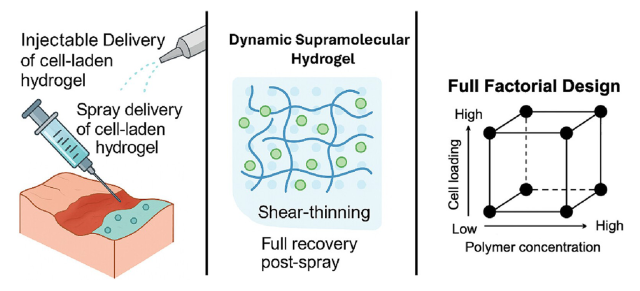
Researchers developed a design framework for cell-laden hydrogels capable of withstanding high-shear delivery, such as injection and spray, by comparing supramolecular peptide amphiphile (PA) hydrogels with conventional covalent alginate systems. Using a full factorial design of experiments (DoE), they systematically evaluated how polymer concentration and cell loading influence mechanical properties, adhesion, and sprayability. The supramolecular PA hydrogels exhibited shear-thinning, rapid self-healing, and robust structural recovery, maintaining integrity even at high cell loadings (up to 2 × 10⁶ cells/mL). In contrast, alginate hydrogels showed significant loss of stiffness and network integrity under similar conditions.
Importance of the Achievement
Delivering living cells to complex or damaged tissues remains a major challenge in regenerative medicine, particularly under high-shear conditions encountered during injection or spray application. This work establishes clear structure–property relationships that link hydrogel chemistry to performance during delivery. The results show that dynamic supramolecular networks can accommodate high cell densities without compromising mechanical stability, enabling minimally invasive delivery while preserving cell viability and localization.
Synergies with BioPACIFIC MIP
BioPACIFIC MIP enabled this work through the synthesis and characterization of peptide amphiphiles that form the supramolecular hydrogel platform. This support was critical to developing and validating materials capable of maintaining performance during high-shear cell delivery.
