

From Lipoic Acid to 1,2-Dithianes: Expanding Radical Ring-Opening to Less-Activated Monomers Such as Vinyl Acetate
Sustainable, high-performance polymers aligned with scalable manufacturing
PIs and Institution
Parker T. Morris, Sarah C. Olsen, Marvin Santiago, Hanlin M. Wang, Elliott H. Denton, Javier Read de Alaniz Christopher M. Bates, Kaitlin R. Albanese, Craig J. Hawker, UCSB
Achievement
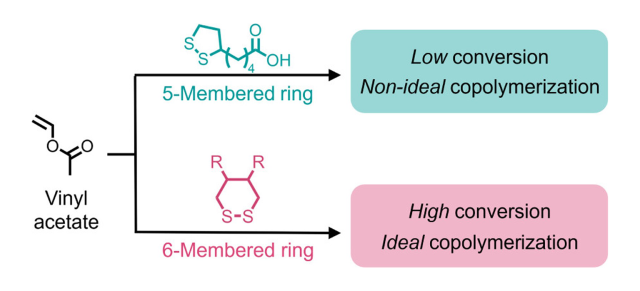
Researchers developed a new class of degradable vinyl copolymers by introducing six-membered cyclic disulfides (1,2-dithianes) into conventional free-radical polymerization. This approach enables, for the first time, efficient radical ring-opening copolymerization with less-activated monomers such as vinyl acetate. The system achieves high conversions (>90%) and tunable molecular weights (~10–100 kg/mol) under simple, scalable conditions. By incorporating cleavable sulfur-based linkages directly into the polymer backbone, the resulting materials span a wide range of mechanical properties from elastomeric to semicrystalline.
Importance of the Achievement
This work represents a key advance in expanding radical ring-opening polymerization to previously inaccessible monomer classes. Traditional approaches are limited to more-activated monomers, restricting their relevance to commodity plastics. By enabling compatibility with non-activated monomers like vinyl acetate—an industrially important feedstock used in adhesives, coatings, and plastics—this research provides a practical pathway toward degradable versions of widely used materials. Importantly, even minimal incorporation of the dithiane units (~1 mol%) leads to dramatic improvements in mechanical performance (over 4000% increase in toughness) while introducing selectively cleavable bonds for controlled degradation. These results directly advance the design of sustainable, high-performance polymers aligned with scalable manufacturing.
Synergies with BioPACIFIC MIP
This work aligns with BioPACIFIC MIP’s mission to advance sustainable polymer synthesis through new building blocks. By extending radical ring-opening polymerization to non-activated monomers, it supports scalable strategies for degradable materials.
