

Biosourced Functional Hydroxybenzoate-co-Lactide Polymers with Antimicrobial Activity
A new class of bio-derived hydroxybenzoate-co-lactide polymers inspired by naturally occurring depsides
PIs and Institution
Pedro Salas-Ambrosio, Shelby Vexler, Niko Vlahakis, Ryan S. Lai, Colin Johnson, Haillie Lower, Abigail G. Doyle, Yi Tang, Jose A. Rodriguez, Irene A. Chen, Javier Read de Alaniz, Heather D. Maynard, UCLA, UCSB
Achievement
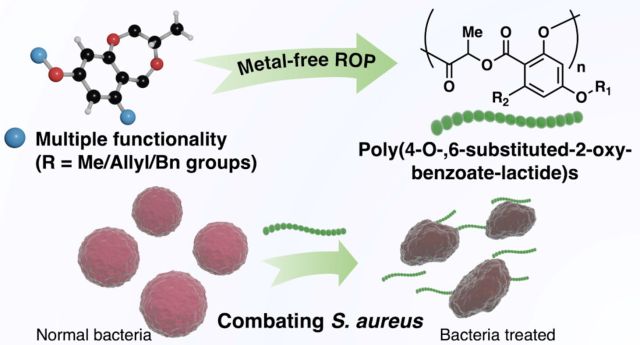
Researchers developed a new class of bio-derived hydroxybenzoate-co-lactide polymers inspired by naturally occurring depsides, a family of compounds known for antimicrobial activity. By combining synthetic biology with controlled polymer chemistry, the team generated a library of functional polymers with tunable side-chain chemistry and molecular weight. Several of the resulting materials demonstrated strong antibacterial activity against Staphylococcus aureus, including the ability to inhibit and disrupt biofilms, while maintaining good biocompatibility and degradability. The study establishes a versatile strategy for creating functional antimicrobial polymers derived from renewable building blocks.
Importance of the Achievement
Antimicrobial resistance is a growing global challenge that requires new materials capable of preventing infection while minimizing long-term environmental persistence and toxicity. This work demonstrates how bio-derived monomers can be engineered into degradable polymers that retain potent antibacterial activity while offering improved control over molecular structure and performance. The ability to tune antimicrobial activity, degradability, and cytocompatibility provides new design principles for polymer therapeutics and coatings for biomedical devices, wound care materials, and other applications requiring long-lasting antimicrobial protection.
Synergies with BioPACIFIC MIP
This work represents a major in-house effort spanning multiple BioPACIFIC MIP investigators focused on sustainable, bio-derived polymer platforms. BioPACIFIC MIP supported the synthesis, characterization, and evaluation of these antimicrobial materials through its shared facilities and collaborative research environment. Student researchers Pedro Salas-Ambrosio, Shelby Vexler, Niko Vlahakis, Ryan Lai, Colin Johnson, and Haillie Lower were supported as BioPACIFIC MIP Fellows, demonstrating the platform’s role in advancing both innovative materials research and workforce development.
