

BARCODE: high throughput screening and analysis of soft active materials
An open-access software platform to enable high-throughput screening and analysis of soft active materials from microscopy data.
PIs and Institution
Qiaopeng Chen, Aditya Sriram, Ayan Das, Katarina Matic, Maya Hendija, Keegan Tonry, Jennifer L. Ross, Moumita Das, Ryan J. McGorty, Rae M. Robertson-Anderson & Megan T. Valentine, University of San Diego
Achievement
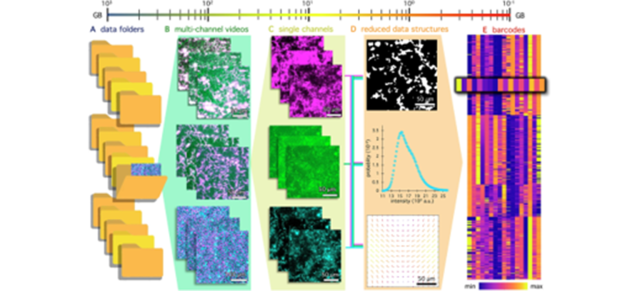
An open-access software platform, BARCODE (Biomaterial Activity Readouts to Categorize, Optimize, Design and Engineer), was developed to enable high-throughput screening and analysis of soft active materials from microscopy data. The platform converts large, complex video datasets into compact “barcodes” of quantitative metrics that capture key structural and dynamic behaviors. By combining multiple analysis approaches, BARCODE reduces data size by orders of magnitude while preserving essential information about material activity, flow, and organization. The method is broadly applicable across diverse systems, including cytoskeletal networks and cell monolayers, enabling rapid comparison and identification of emergent behaviors.
Importance of the Achievement
Active and responsive materials generate large, complex datasets that are difficult to analyze, limiting the ability to establish clear relationships between material design and performance. This work addresses a critical bottleneck by providing a standardized, material-agnostic framework for rapidly extracting meaningful insights from microscopy data. By dramatically reducing data dimensionality while retaining key physical descriptors, BARCODE enables faster screening, comparison, and optimization of complex materials systems. The platform also lowers barriers to data sharing and analysis, supporting broader accessibility and accelerating discovery in fields ranging from biomaterials to active matter and soft robotics.
Synergies with BioPACIFIC MIP
BioPACIFIC MIP enabled this work through access to computational resources and community-driven programming efforts, including hackathon events that supported development of the BARCODE platform. The facility also provided access to high-throughput microrheology tool, which were critical for generating and analyzing the large experimental datasets used to develop and validate the software.
